
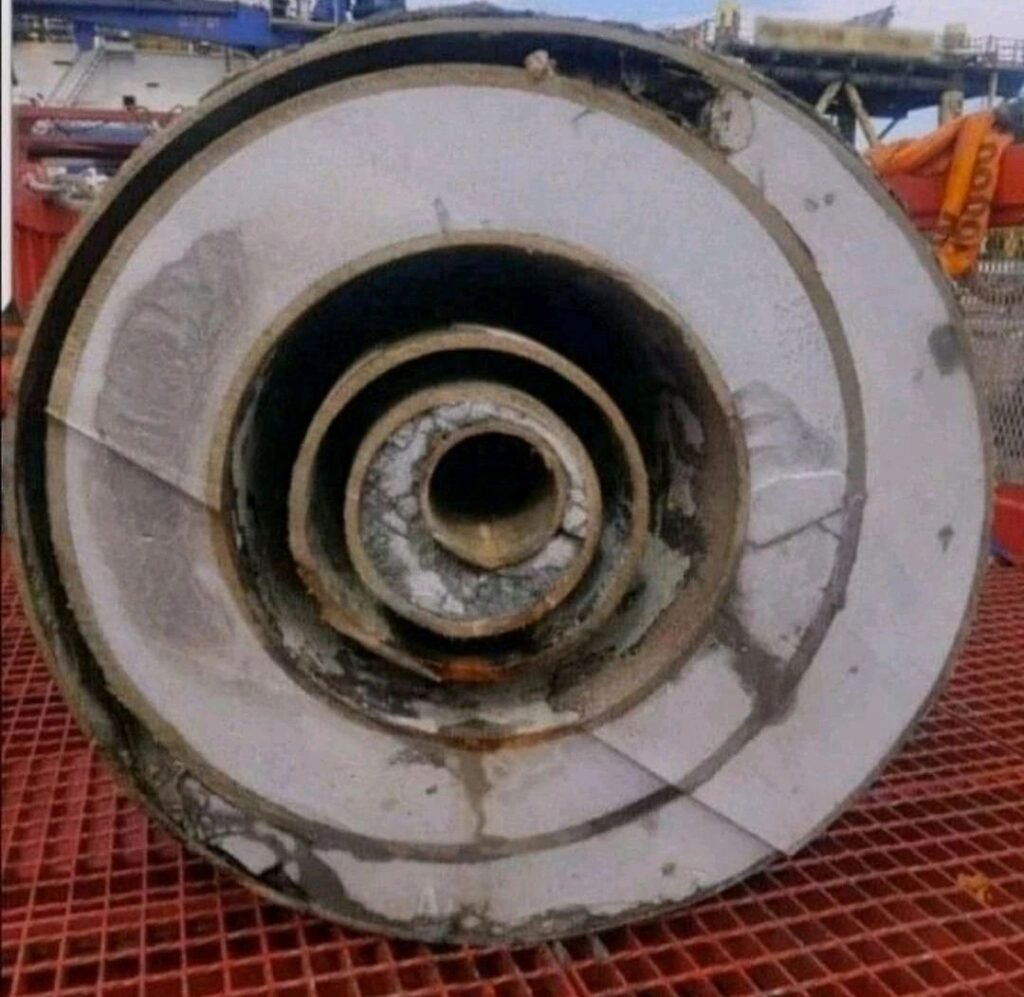
The image below shows a cross-section of a multi-string casing system—a perfect visual representation of why Well Cementing is one of the most critical stages in drilling operations.
In simple terms, cementing is the process of pumping a cement slurry into the annular space between the steel casing and the drilled wellbore. But it’s much more than just “filling a gap.”
Why is it so critical?
✓ Zonal Isolation: It prevents the migration of fluids (like water or gas) between different geological layers, protecting oil reservoirs from contamination.
✓ Structural Integrity: It supports and anchors the casing string, protecting it against external geopressures.
✓ Corrosion Protection: The cement sheath acts as a shield for the steel pipe against corrosive formation waters.
✓ Pressure Control: It ensures the safety of the well by preventing uncontrolled fluid flows (blowouts).
How does it work?
The most common method is the “Two-Plug” technique:
- Preparation: The casing is lowered into the well.
- Bottom Plug: Dispatched before the cement to prevent contamination with drilling mud.
- Cement Injection: The calculated volume of slurry is pumped down.
- Top Plug: Pushed by drilling fluid to displace the cement out of the casing shoe and up into the annulus.
- WOC (Waiting on Cement): A critical pause to allow the slurry to harden and gain strength.
Ensuring Quality
Post-operation, we use CBL (Cement Bond Log)—a geophysical tool that measures how well the cement has bonded to the casing and the formation. As seen in the photo, a uniform, gap-free cement ring is the key to a well’s long-term productivity and safety.
Efficiency in the oilfield starts with a solid foundation!