
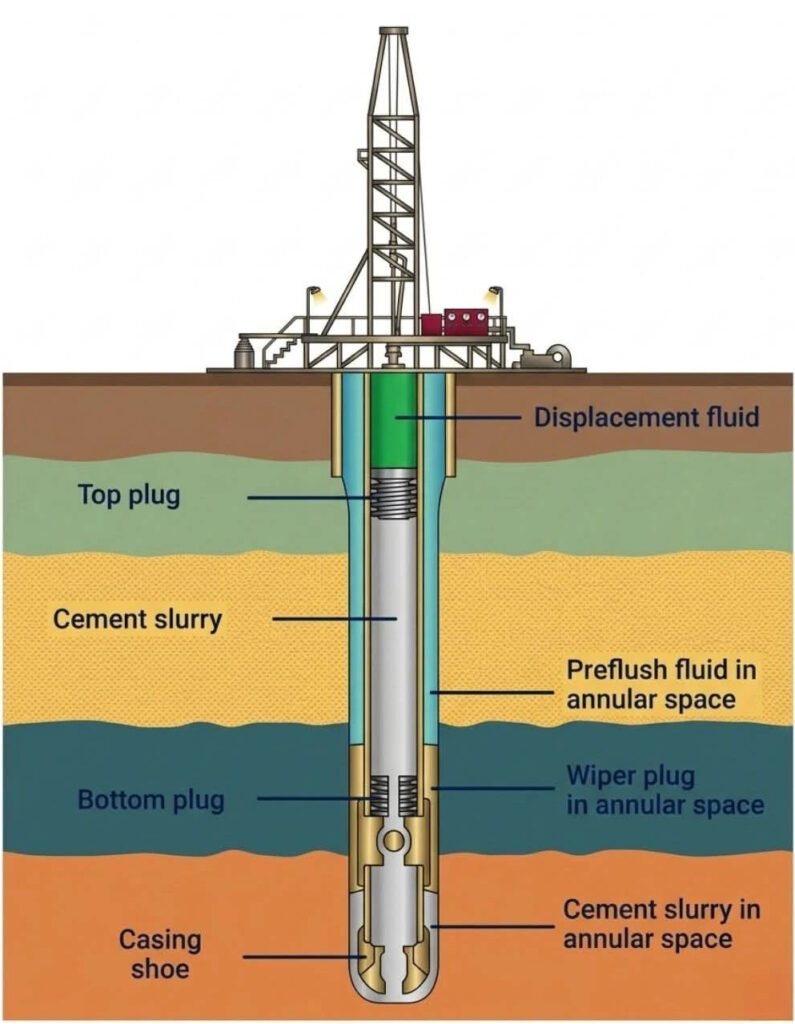
Cementing is not just about mixing cement and pumping it downhole. It is a precise engineering process where the success of the entire well integrity depends on how the cement slurry is designed. Additives are the key element that transforms ordinary Portland cement into a system capable of performing under a wide range of downhole conditions.
Each well presents different challenges such as temperature, pressure, formation strength, and fluid behavior. That is why selecting the right additive with the correct concentration is critical. A poor selection can lead to serious problems like lost circulation, weak bonding, or even complete failure of the cement job.
Additives are used to control the behavior of the cement slurry and ensure it performs exactly as required. The main categories include accelerators, retarders, extenders, fluid loss agents, dispersants, and other specialized chemicals designed for specific conditions.
Accelerators are used to reduce the setting time of cement. They are essential in shallow wells where temperatures are low, helping the cement reach the required compressive strength faster and minimizing waiting on cement time. This directly reduces rig time and operational cost.
Retarders work in the opposite way. They are used to delay the setting time, especially in deep wells where temperatures are high. Without retarders, the cement could set too quickly before placement is complete, leading to major operational risks.
Lightweight additives, also known as extenders, are used to reduce slurry density. This is critical in weak formations with low fracture gradients, where heavy cement could break the formation and cause losses. However, reducing density usually comes with a trade-off in strength and thickening time.
Heavyweight additives are introduced when higher density is required, particularly in overpressured zones. These additives help maintain well control and ensure proper zonal isolation under high-pressure conditions.
Fluid loss additives play a vital role in preventing the loss of water from the slurry into permeable formations. Controlling fluid loss ensures proper hydration of cement and maintains its designed properties.
Friction reducers, or dispersants, improve the flow behavior of the slurry. They reduce pumping pressure and enhance placement efficiency, especially in long or complex well sections.
In cementing operations, there is no universal design. Every slurry is engineered based on well conditions, and every additive is selected for a reason. The difference between a successful cement job and a failed one often lies in these small but critical details.