
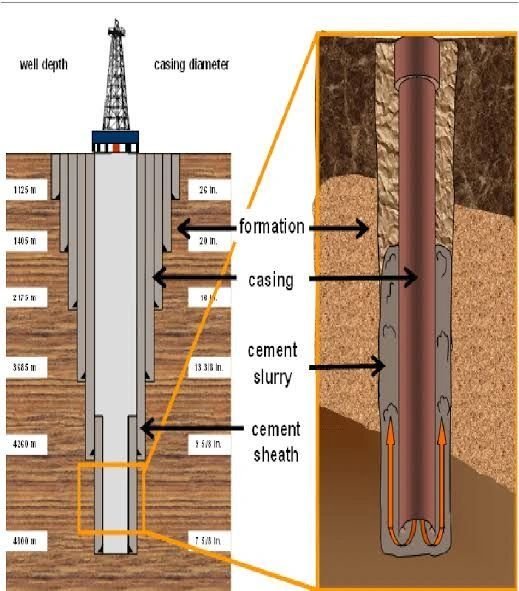
What Is Casing?
Casing refers to the steel pipes that are run into a wellbore after it has been drilled. These pipes are installed in sections (strings) and serve multiple functions:
Prevent well collapse by supporting the wellbore wall.
Isolate pressure zones and prevent fluid migration.
Provide a conduit for production tubing and completion equipment.
Types of Casing Strings:
- Conductor Casing: The first casing installed; prevents surface collapse and provides a foundation for the wellhead.
- Surface Casing: Protects freshwater zones and supports blowout preventers.
- Intermediate Casing: Isolates unstable or high-pressure formations.
- Production Casing: Extends to the reservoir and allows hydrocarbons to flow to the surface.
- Liner: A shorter casing section hung inside a previous casing string, used for cost savings or specific design needs.
Cementing Operations
Once casing is in place, cementing is performed by pumping cement slurry into the space between the casing and the borehole wall (annulus). The cement hardens to:
Secure the casing in place.
Provide zonal isolation, preventing fluid movement between formations.
Protect casing from corrosion and subsurface pressure.
Stages of Cementing:
- Mud Removal: Displacement of drilling fluid using spacers and flushes.
- Cement Slurry Pumping: Cement is mixed at surface and pumped down the casing.
- Displacement with Wiper Plugs: Plugs help separate fluids and push cement into the annulus.
- Curing: The cement sets and hardens, forming a solid sheath.
Importance of Proper Casing and Cementing
Well Integrity: Prevents blowouts and ensures pressure control.
Environmental Protection: Isolates groundwater zones from hydrocarbon-bearing formations.
Efficient Production: Zonal isolation allows for selective stimulation and production.
Challenges and Solutions
Cement Channeling: Poor mud removal can cause weak spots. Solution: Optimized hole cleaning and centralization.
Loss Circulation: Cement loss to formation. Solution: Use of lost circulation materials (LCMs) or lightweight cement.
Gas Migration: Gas can invade unset cement. Solution: Gas-tight slurries and proper pressure control.
Recent Innovations
Expandable casing systems: Reduce casing sizes and improve wellbore access.
Self-healing cement: Reacts to cracks or pressure changes to maintain sealing.
Real-time cement evaluation tools: Use of sonic logs and pressure sensors to confirm cement placement and integrity.