
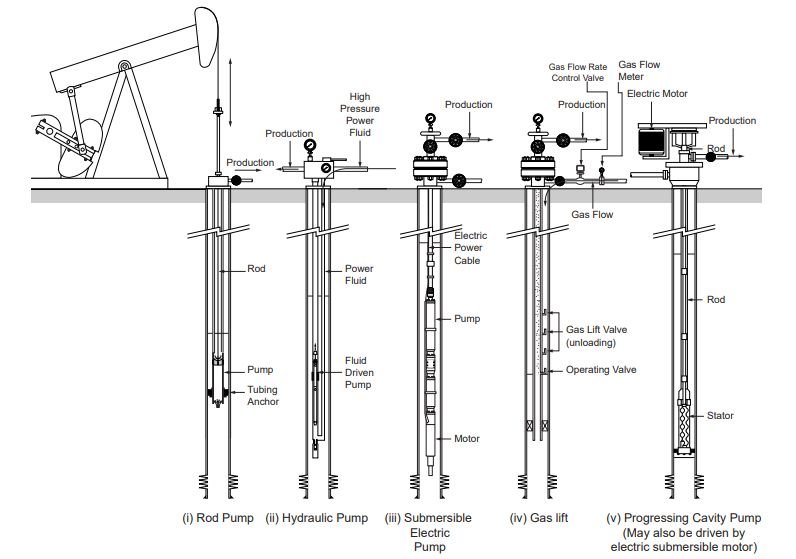
The most popular forms of artificial lift are:
(i) Rod Pumps – A downhole plunger is moved up and down by a rod connected to an engine at the surface. The plunger movement displaces produced fluid into the tubing via a pump consisting of suitably arranged travelling and standing valves mounted in a pump barrel.
(ii) Hydraulic Pumps use a high-pressure power fluid to:
(a) drive a downhole turbine pump or
(b) flow through a venturi or jet, creating a low-pressure area which produces an increased drawdown and inflow from the reservoir.
(iii) Electric Submersible Pump (ESP) employs a downhole centrifugal pump driven by a three phase, electric motor supplied with electric power via a cable run from the surface on the outside of the tubing.
(iv) Gas Lift involves the supply of high-pressure gas to the casing/tubing annulus and its injection into the tubing deep in the well. The increased gas content of the produced fluid reduces the average flowing density of the fluids in the tubing, hence increasing the formation drawdown and the well inflow rate.
(v) Progressing Cavity Pump (PCP) employs a helical, metal rotor rotating inside an elastomeric, double helical stator. The rotating action is supplied by downhole electric motor or by rotating rods.