
Drilling a well to Total Depth (TD) is only half the mission.
A well without proper completion is simply a deep and expensive hole in the ground.
Well Completion is the process of transforming a drilled well into a safe, controlled, and economically productive hydrocarbon producer. It involves installing specialized downhole equipment and preparing the reservoir for long-term oil and gas production while maintaining well integrity, zonal isolation, and flow efficiency.
Before completion operations begin, formation evaluation (FE) data obtained from open-hole logging tools is carefully analyzed to determine:
✔️ Reservoir quality
✔️ Hydrocarbon saturation
✔️ Porosity and permeability
✔️ Fluid contacts
✔️ Commercial production potential
Based on this evaluation, engineers decide whether the well should be:
- Completed for production
- Suspended for future use
- Or Plugged & Abandoned (P&A) if non-commercial
Once the reservoir interval is confirmed, production casing is run into the wellbore and cemented in place. Cementing is one of the most critical barriers in the entire well lifecycle because its primary purpose is to:
🔹 Prevent fluid migration between formations
🔹 Protect freshwater zones
🔹 Provide structural support to casing
🔹 Maintain pressure integrity throughout production
To verify cement quality, engineers perform a Cement Bond Log(CBL). This log evaluates the bonding between casing, cement sheath, and formation.
Poor cement bonding can result in:
⚠️ Gas migration
⚠️ Water production
⚠️ Sustained casing pressure
⚠️ Crossflow between zones
⚠️ Loss of well integrity
If channels or micro-annuli are detected, remedial cementing operations such as a Cement Squeeze are performed to restore zonal isolation and ensure long-term well performance.
After cement integrity is confirmed, the drilling mud is displaced with specially designed Completion Fluids or brines. These fluids are engineered to:
🧪 Minimize formation damage
🧪 Control formation pressure
🧪 Prevent clay swelling and emulsions
🧪 Maintain compatibility with reservoir fluids
The completion phase may also include:
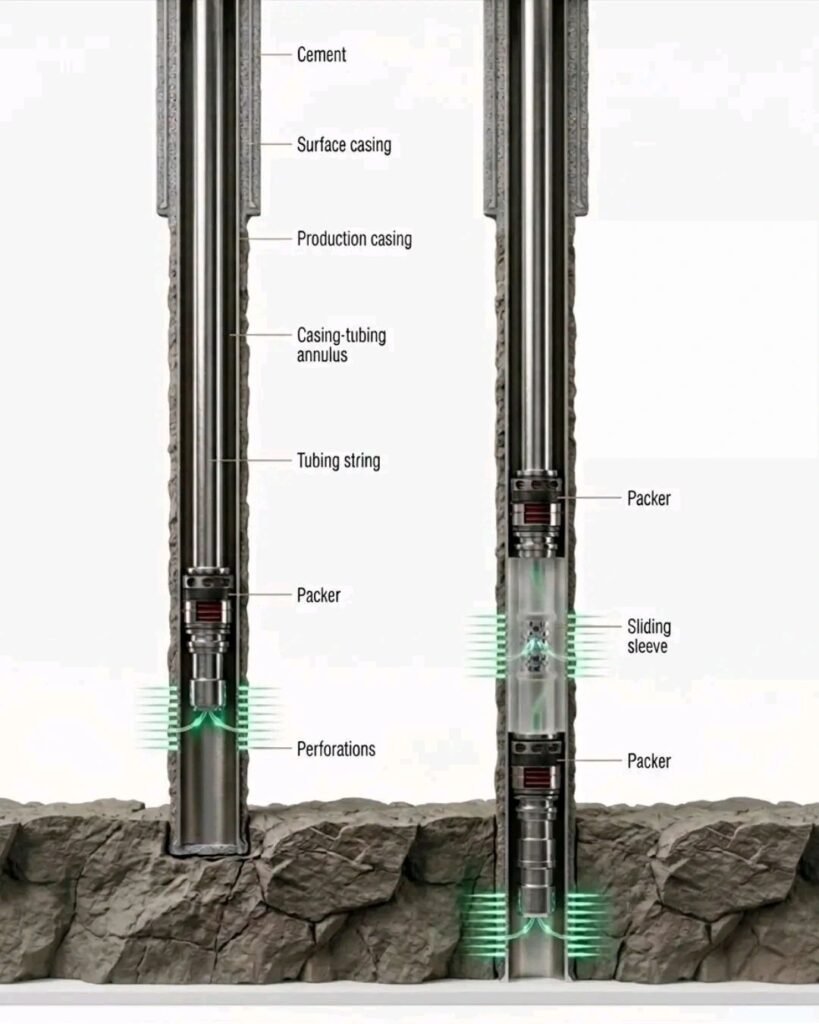
🔹 Perforating the casing across productive zones
🔹 Installing production tubing and packers
🔹 Sand control systems
🔹 Intelligent completion equipment
🔹 Safety valves and flow control devices
🔹 Hydraulic fracturing or stimulation treatments
A successful completion is not only about bringing hydrocarbons to surface — it is about maximizing recovery, minimizing operational risks, extending well life, and ensuring safe production for years or even decades.
In the oilfield, drilling creates access to the reservoir…
But Well Completion determines whether the well becomes profitable or problematic.