
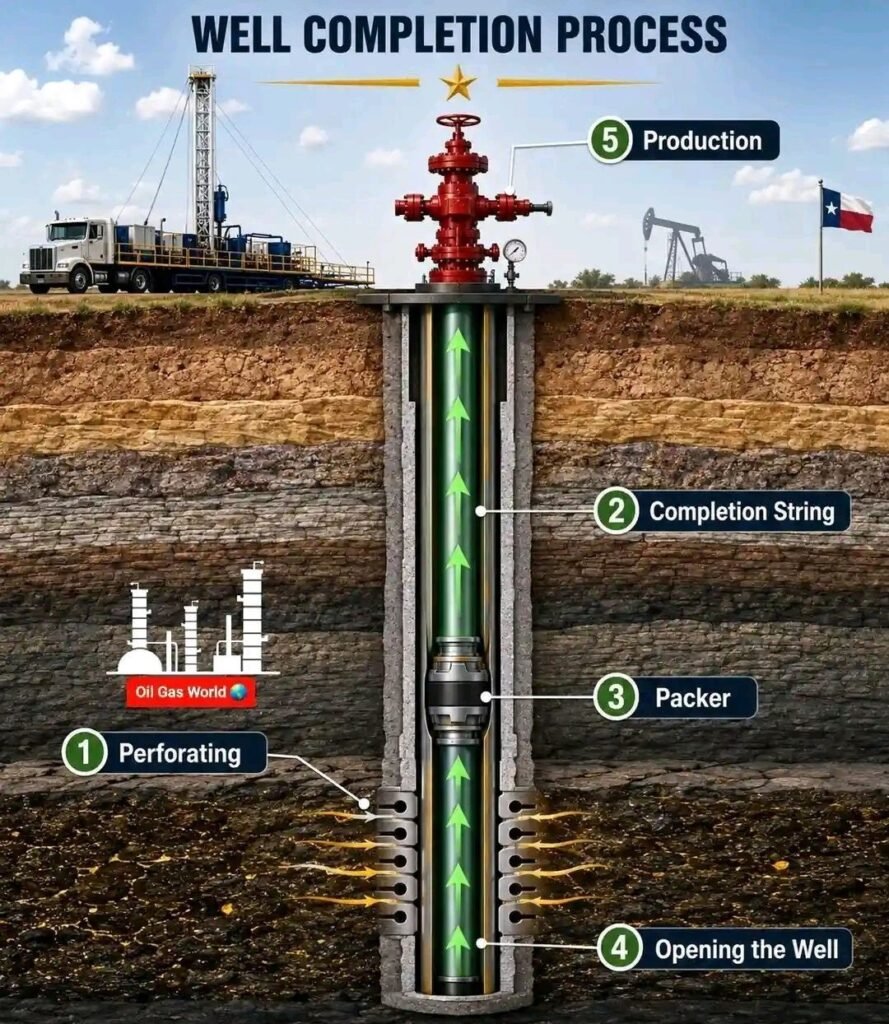
Basically what happens after a well has been drilled to make it ready for production. It shows a vertical cross-section of the ground with equipment installed inside the well.
Here’s what each labeled step means:
- Perforating
Small explosive charges are used to create holes in the casing and cement at the depth of the oil- or gas-bearing rock. These perforations allow hydrocarbons to flow from the reservoir into the well.
- Completion String
This is the tubing placed inside the well through which oil or gas travels to the surface. It includes pipes and other equipment designed to control and guide the flow safely.
- Packer
A sealing device installed between the tubing and the casing. It isolates different zones in the well and prevents fluids from flowing in unwanted directions, ensuring efficient production.
- Opening the Well
Once everything is in place, the well is opened so oil or gas can start flowing through the perforations into the tubing.
- Production
Hydrocarbons move upward through the tubing to the surface. The image shows arrows indicating this upward flow, ending at the wellhead (the red structure at the top).
Additional details in the image:
The surrounding rock layers represent underground geological formations.
Yellow arrows at the perforation level show oil/gas entering the well.
Surface equipment includes a drilling rig truck and a pumpjack in the background.
The wellhead controls pressure and flow at the surface.
In short, the diagram shows how a drilled well is equipped and activated to safely bring oil or gas from underground reservoirs to the surface.