
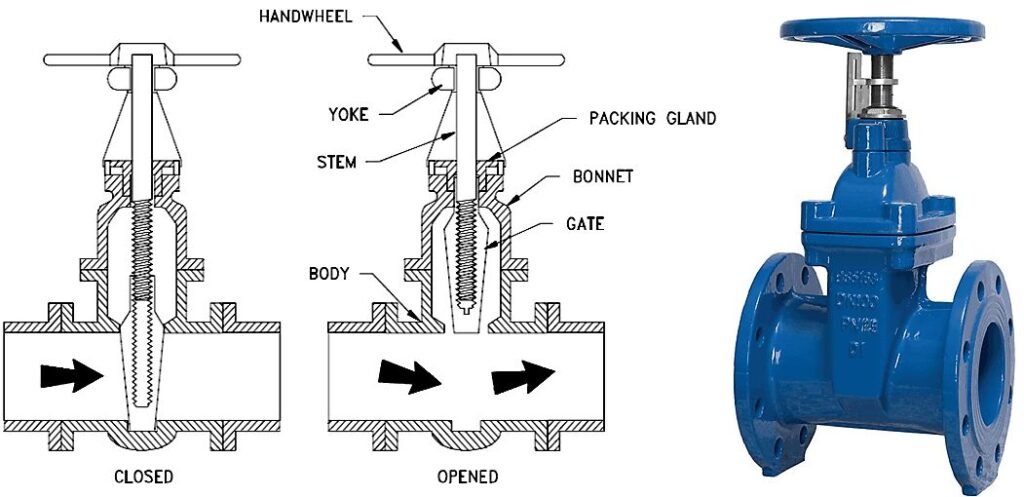
A gate valve is a linear motion valve designed primarily for isolation service. It operates by lifting a gate (wedge or parallel disc) out of the flow path to allow full flow, or lowering it to completely stop flow.
In its fully open position, it offers minimal pressure drop, making it ideal for systems where unrestricted flow is required.
So what is it actually used for?
Simple: full open or full close applications.
Think of:
- Wellhead isolation
- Flowline isolation
- Tank inlet/outlet shutoff
- Pipeline sectionalizing
Where things go wrong is when gate valves are used for throttling (flow regulation).
Gate valves are not designed for that purpose.
When a gate valve is partially open:
- Flow becomes highly turbulent across the gate
- The valve experiences vibration and chatter
- Seating surfaces are exposed to erosion and wire drawing
- Uneven wear develops, leading to poor sealing over time
In crude oil systems, especially with sand or wax content, this gets worse.
Sand particles accelerate erosion of the gate and seat, and you eventually end up with a valve that neither shuts properly nor regulates effectively.
Using a gate valve for throttling might seem convenient in the moment, but it is a shortcut that leads to:
- Equipment failure
- Poor process control
- Increased maintenance costs
This is where choke valves, globe valves, or control valves should be used – equipment specifically designed to handle throttling conditions.
In oil & gas operations, discipline in equipment selection directly impacts safety, efficiency, and asset integrity.
Right valve. Right service. Every time.