
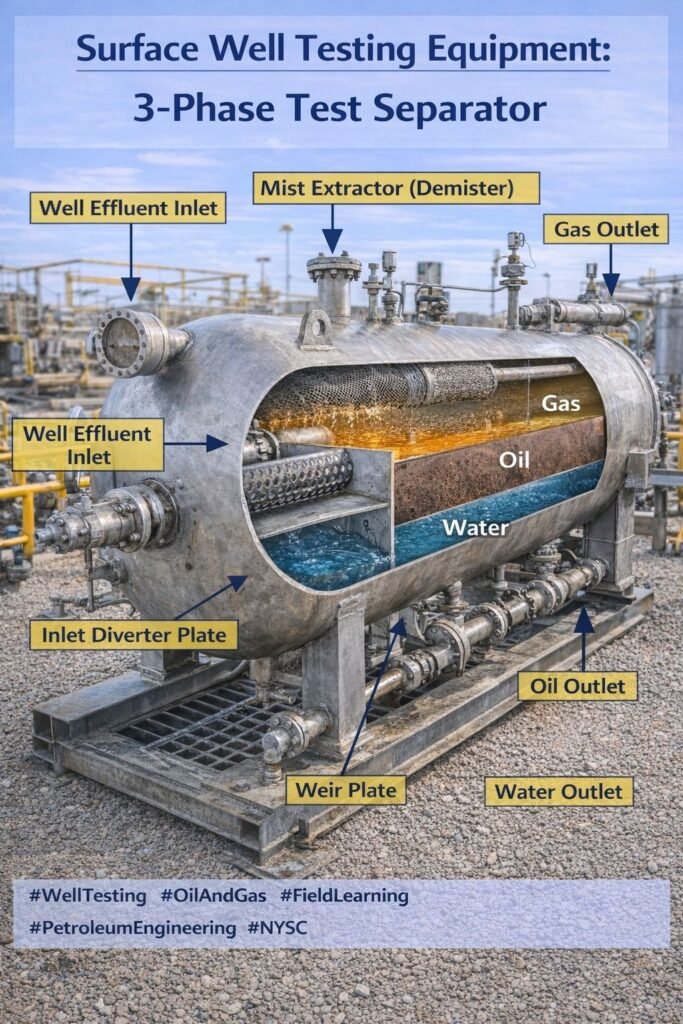
A 3-Phase Separator is a critical piece of equipment in upstream oil & gas operations, designed to efficiently split the wellstream into gas, oil, and produced water.
Working Principle
The separation process relies on gravity separation and density differences:
Gas (lowest density) rises to the top
Oil settles in the middle layer
Water (highest density) accumulates at the bottom
Key Separation Stages
1) Inlet Section
The incoming flow enters through an Inlet Diverter, which reduces momentum and initiates bulk gas-liquid separation.
2) Gravity Settling Zone
Remaining liquids undergo phase separation based on density:
Oil floats above water
Water settles at the bottom
A Weir helps maintain proper phase boundaries.
3) Gas Polishing Section
Gas passes through a Mist Extractor (Demister) to remove entrained liquid droplets before exiting the vessel.
Control & Operation
Efficient performance is maintained using:
Level Controllers (oil/water interface control)
Pressure Control Valve (PCV)
Adequate Retention Time
Key Challenges
Emulsions affecting oil-water separation
Liquid Carryover in gas
Water Carryunder in oil
Conclusion
The 3-Phase Separator is the first and most essential step in surface processing, ensuring stable and efficient downstream operations by leveraging fluid dynamics and phase behavior.