
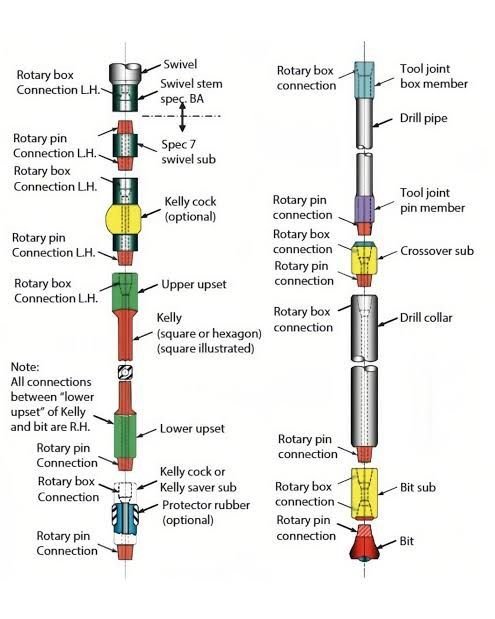
The drill string is more than just connected pipes — it is the mechanical link between surface power and downhole drilling action.
Every component has a role.
If one fails, the entire operation is at risk.
1- Drill Collars (DC)
Thick-walled, heavy tubulars placed above the bit.
- Provide weight on bit (WOB)
- Keep the bit stable and drilling straight
- Reduce buckling in the drill pipe
2- Heavy Weight Drill Pipe (HWDP)
A transition between drill collars and drill pipe.
- Reduces stress concentration
- Improves string flexibility
- Helps control buckling in directional wells
3- Drill Pipe (DP)
The longest section of the drill string.
- Transmits torque and rotation
- Circulates drilling fluid
- Allows connection of surface equipment to downhole tools
4- Stabilizers
Used to control hole direction and BHA stability.
- Maintain hole gauge
- Reduce vibration
- Improve directional control
5- Reamers and Hole Openers
Tools used to maintain or enlarge hole size.
- Reduce torque and drag
- Improve hole quality
- Help prevent tight spots
6- Downhole Motors / Rotary Steerable Systems (RSS)
Provide rotation at the bit independent of surface rotation.
- Essential for directional and horizontal drilling
- Improve trajectory control
- Increase drilling efficiency
7- Subs (Connections & Crossovers)
Short tools connecting different components.
- Allow compatibility between tools
- Transfer loads safely
- Often overlooked but critical
Which drill string component do you believe has the biggest impact on drilling performance — and why?